
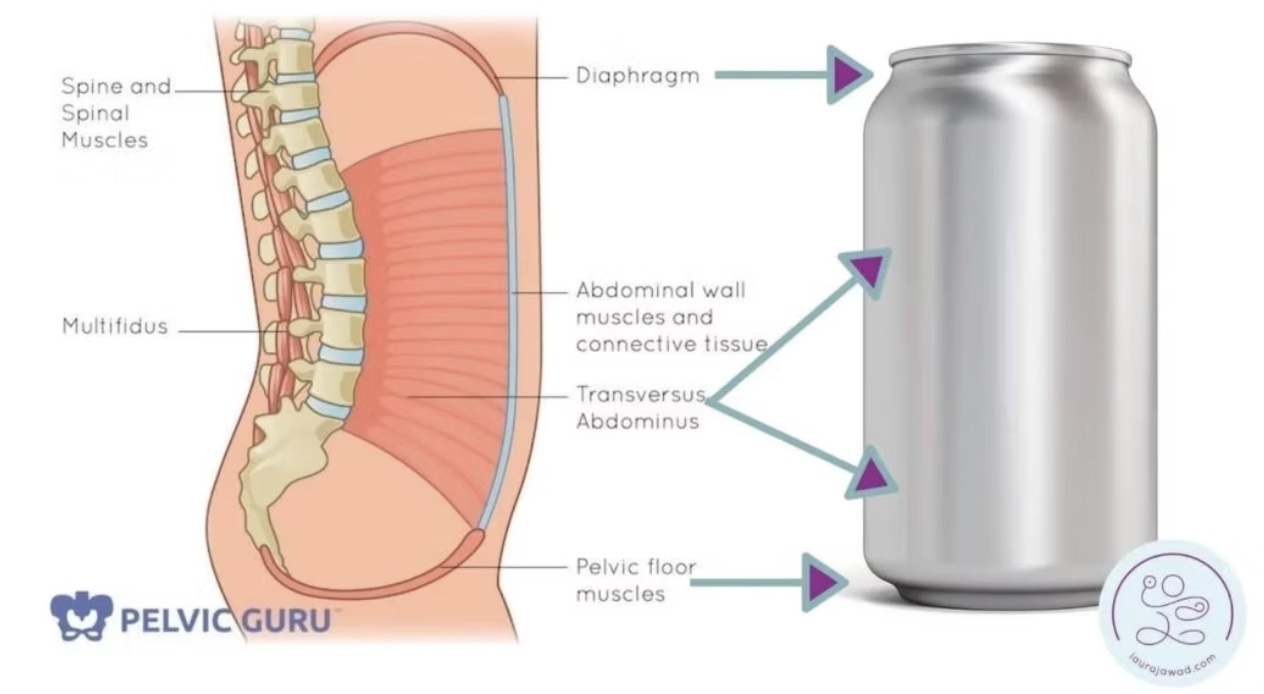
Our pelvic floor has many important functions including bowel and bladder control, supporting our internal organs, and providing strength and stability for our daily activities. Another vital role that our pelvic floor has is helping to manage our body’s intra-abdominal pressure. Intra-abdominal pressure or IAP is the amount of pressure within our trunk’s abdominal cavity, which is surrounded by 4 walls. The roof of this cavity consists of our diaphragm, which expands and contracts as we breathe. The front wall is made up of our transverse abdominis and abdominal wall, and the back wall consists of our spine and multifidus muscles. The bottom is made up of our pelvic floor muscles, which create a bowl at the base of our abdominal cavity.
https://www.laurajawad.com/post/an-introduction-to-your-pelvic-floor/
Why is pressure management important?
Just like a soda can, our abdominal cavity needs to maintain a certain pressure in order to function correctly. If the pressure within a soda gets too high, or the seal is cracked, the internal pressure will be affected. Several conditions are associated with poor pressure management including:
- Prolapse
- Stress incontinence (including incontinence with running, weight lifting, coughing, etc.)
- Pelvic pain and hypertonicity
- Constipation
What are strategies to improve pressure management?
The most important part of pressure management is proper breathing mechanics. As we inhale, our diaphragm descends and our pelvic floor muscles lengthen. You can practice 360 degree breathing, meaning that on your inhale your stomach, ribs, and back gently expand as your lungs fill with air. As you exhale, your diaphragm ascends and your pelvic floor goes back to its resting state. When we hold our breath, particularly with lifting, getting up from a chair, or with bowel movements, we increase the pressure within our abdominal cavity. This creates excess stress to our pelvic floor muscles, which can lead to pelvic floor dysfunction.
A big component of pelvic floor physical therapy is learning proper breathing mechanics in order to build a strong core and pelvic floor, and allow you to participate in your daily tasks and recreational activities without symptoms.
Citations
Park, H., & Han, D. (2015). The effect of the correlation between the contraction of the pelvic floor muscles and diaphragmatic motion during breathing. Journal of physical therapy science, 27(7), 2113–2115. https://doi.org/10.1589/jpts.27.2113
Faubion, S. S., Shuster, L. T., & Bharucha, A. E. (2012). Recognition and management of nonrelaxing pelvic floor dysfunction. Mayo Clinic proceedings, 87(2), 187–193. https://doi.org/10.1016/j.mayocp.2011.09.004
Talasz, H., Kremser, C., Talasz, H. J., Kofler, M., & Rudisch, A. (2022). Breathing, (S)Training and the Pelvic Floor-A Basic Concept. Healthcare (Basel, Switzerland), 10(6), 1035. https://doi.org/10.3390/healthcare10061035